

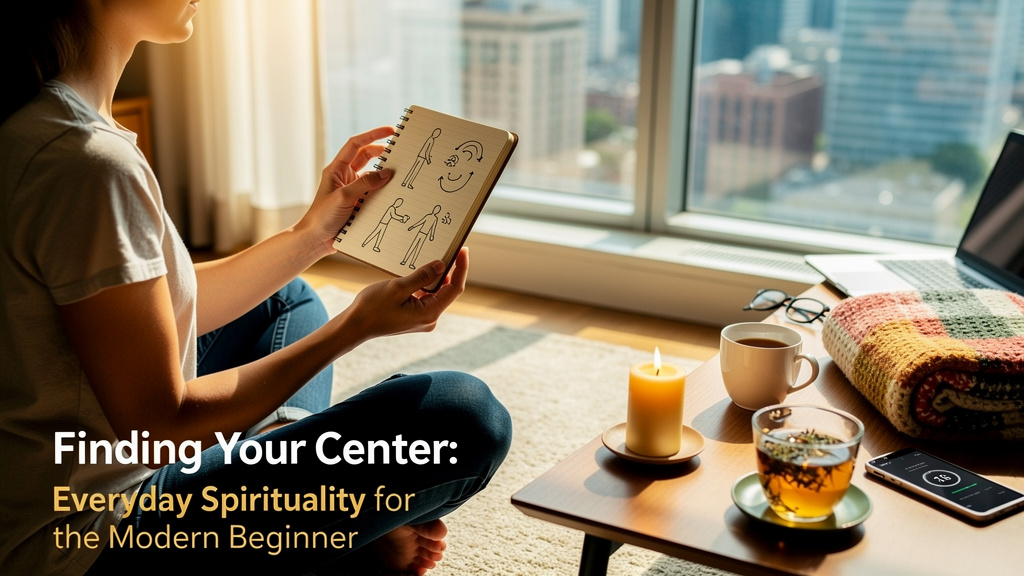
Finding Your Center: Everyday Spirituality for the Modern Beginner
Table of Contents
In a world that moves at the speed of a notification, many people feel pulled in ten directions at once. The constant buzz of email, social media, and endless to-do lists can leave the soul feeling scattered and exhausted. Finding your center is not about escaping modern life or retreating to a mountaintop; it is about discovering a quiet place within yourself that remains steady no matter what is happening around you. This guide is written for the modern beginner who longs for spiritual grounding without complicated rituals or esoteric language.
Everyday spirituality invites you to see the sacred in ordinary moments—the steam rising from your morning coffee, the rhythm of your footsteps on a city sidewalk, the pause between breaths before you answer a difficult phone call. You do not need hours of free time or a dedicated meditation room to begin. What you need is willingness, curiosity, and the courage to start small. Over the next sections, we will explore practical ways to weave spirituality into the fabric of daily living, one gentle step at a time.
Understanding What It Means to Be Centered
To be centered is to inhabit a state of inner alignment where your thoughts, emotions, and actions arise from a place of clarity rather than reactivity. It does not mean you will never feel angry, anxious, or overwhelmed. Instead, it means you have an internal anchor that allows you to notice those feelings without being swept away by them. Think of it like the eye of a hurricane: the winds may rage around you, but at the core there is stillness. For the modern beginner, this stillness is often buried beneath layers of responsibility, expectation, and digital stimulation, but it is always there, waiting to be remembered.
Centering is not a destination you reach and then possess forever. It is a practice, a returning, much like coming home to yourself after a long day away. Some days you will feel deeply grounded, and other days you will feel fragmented and lost. Both experiences are part of the journey. The goal is not perfection but presence. When you are centered, you make decisions from wisdom rather than panic. You listen to others with genuine attention instead of planning your next response. You move through your day with a sense of purpose that is quiet but unshakable.
Many people mistakenly believe that spirituality requires withdrawing from the world or adopting a specific belief system. In truth, everyday spirituality is available to everyone, regardless of religious background or lack thereof. It is about cultivating awareness of the present moment and recognizing that you are part of something larger than your individual worries. Being centered might mean pausing before you send a reactive text, taking a conscious breath before entering a meeting, or simply feeling your feet on the floor as you walk. These small acts of awareness are the building blocks of a centered life.
The modern world often equates busyness with worth, which makes stillness feel suspicious or even lazy. When you first begin to center yourself, you may encounter resistance from your own mind, which insists that you should be doing something productive every second. This resistance is normal. It is the ego’s way of protecting familiar patterns. By gently acknowledging that resistance and choosing to pause anyway, you begin to retrain your nervous system. Over time, centering becomes less of an effort and more of a natural resting place.
As you explore what it means to be centered, keep a gentle journal or mental note of the moments when you feel most at ease. Is it during a walk in the park? While washing dishes? In the quiet before sunrise? These clues point you toward the practices and environments that support your unique center. There is no one-size-fits-all formula. Your center is personal, and discovering it is an act of self-compassion that ripples outward into every relationship and responsibility you hold.
Creating Sacred Space in a Busy World
Sacred space does not require a temple, an altar, or even a spare room. It is any physical or energetic boundary you set aside to remind yourself that you are more than your tasks and obligations. For the modern beginner, creating sacred space might mean clearing a corner of your bedroom for a cushion and a candle, or it might mean designating your morning commute as a time for silence rather than podcasts. The key is intentionality. When you declare a space or a moment sacred, you signal to your subconscious that this is a place for presence, not productivity.
Start small. A single shelf, a windowsill, or even a favorite chair can become an anchor for your spiritual practice. Place an object there that holds meaning for you—a stone from a meaningful walk, a photograph of a loved one, a small plant, or a handwritten word like breathe or enough. These objects are not magical talismans; they are visual cues that invite you to slow down. When your eyes land on them, they can serve as gentle reminders to check in with yourself, to drop your shoulders, and to remember that you are here, now.
Time can also be sacred space. You might carve out five minutes after you wake up before you touch your phone, or ten minutes before bed when you sit in darkness and simply observe your breath. These pockets of time act as sanctuaries within the flow of the day. They do not need to be long to be effective. In fact, brief but consistent moments of sacred time often have a deeper impact than occasional retreats because they train you to return to center repeatedly, building a habit of inner return.

In a busy household or open-plan office, physical privacy may be impossible. That is when energetic boundaries become essential. You can create sacred space with sound, scent, or ritual. Lighting a stick of incense, playing a single bell tone, or wrapping your hands around a warm mug of tea can mark the transition from ordinary time to sacred time. Your body begins to associate these cues with stillness, making it easier to settle into presence even when the world around you is loud.
Remember that sacred space is not about perfection. If your meditation corner becomes a place where laundry piles up, that is okay. If your sacred morning moment is interrupted by a child or a pet, that is also okay. The practice is not the pristine environment; it is your willingness to return to center again and again, regardless of conditions. Over time, you may find that you carry this sense of sacred space within you, so that even in a crowded subway or a stressful meeting, you can access an inner stillness that no external circumstance can take away.
Simple Daily Practices for the Modern Beginner
Spirituality does not have to be complicated to be meaningful. Some of the most powerful practices are the simplest ones, because they are sustainable over the long term. For the modern beginner, the goal is not to add more to your already overflowing plate but to infuse your existing routines with awareness. You can begin with practices that take less than five minutes and require no special equipment. The consistency of these small acts matters far more than their duration or complexity.
One foundational practice is the morning intention. Before you get out of bed, take three slow breaths and silently name one quality you wish to embody that day—patience, curiosity, kindness, or courage. This takes less than a minute, yet it sets a directional tone for your awareness. When challenges arise later, you can recall your intention and ask whether your response aligns with it. This simple check-in creates a bridge between your spiritual aspirations and your everyday actions.
Another accessible practice is mindful transitions. Most of our stress accumulates in the gaps between activities—the moment we hang up the phone and open our email, or the moment we walk through the front door after work. Instead of rushing through these thresholds, pause for three breaths. Feel your feet on the ground, notice the temperature of the air, and acknowledge the shift from one role to another. These micro-pauses prevent the day from blurring into one continuous rush and give you opportunities to recentre repeatedly.
Gratitude is a classic spiritual practice for good reason. It shifts your attention from what is lacking to what is present. You do not need a formal journal. Simply name three things you are grateful for while brushing your teeth, waiting for the kettle to boil, or stopping at a red light. They can be small: the warmth of water, a text from a friend, the fact that you woke up today. When you make gratitude a habitual lens, you train your mind to notice abundance even in ordinary circumstances.
Evening reflection completes the daily cycle. Before sleep, review your day with gentle curiosity rather than judgment. Ask yourself: When did I feel centered today? When did I feel scattered? What made the difference? You do not need to fix anything in this moment. Simply observing the patterns of your energy and attention builds self-knowledge. Over weeks and months, you will begin to see which people, places, and activities support your center and which ones pull you away from it.
Finally, remember that missing a day does not mean you have failed. Spirituality is not a streak to be maintained but a relationship to be nurtured. If you skip your morning intention or forget to pause between tasks, simply begin again the next moment. The modern beginner benefits most from self-compassion. Each breath is a new opportunity to return to center, and each day is a fresh invitation to live with a little more awareness, a little more kindness, and a little more trust in the quiet wisdom within.
”“Navigating Distractions and Digital Noise
In the modern world, distraction is not merely an inconvenience; it is an industry. Every app, platform, and device is engineered to capture and hold your attention, often by triggering mild anxiety or the promise of reward. For the beginner seeking spiritual center, this environment presents a unique obstacle. It is difficult to hear the quiet voice within when your pocket vibrates every few minutes, when your inbox overflows, and when your mind has grown accustomed to constant stimulation. Digital noise does not just occupy your time; it occupies your nervous system, keeping you in a state of low-grade alertness that makes stillness feel unfamiliar, even unsafe.
The first step in navigating this terrain is not to reject technology outright, but to bring conscious awareness to your relationship with it. You might begin by designating certain spaces or times as device-free: the dinner table, the first thirty minutes after waking, or the hour before sleep. Turn off non-essential notifications so that your phone serves you rather than the other way around. Consider a weekly digital sabbath, even if it is only a few hours long, during which you step away from screens and reconnect with the physical world. These boundaries are not rigid rules but experiments in sovereignty. Each time you choose not to reach for your phone in a moment of boredom, you are reclaiming a fragment of your attention and offering it back to your own life.
Beyond external boundaries lies the inner work of noticing the impulse to distract yourself. When you feel the urge to check social media during a quiet moment, pause and ask what you are avoiding. Is it loneliness, discomfort, or the simple unfamiliarity of silence? Treat that urge not as a failure but as a teacher. The discomfort you feel when unplugged is often the surface of deeper spiritual hunger. By sitting with it briefly, by breathing through the restlessness, you begin to retrain your mind to tolerate stillness. Over time, you may discover that the space between notifications is where your center actually lives—not in the constant stream of input, but in the quiet intervals that modern life so often tries to fill.
Connecting with Breath, Body, and Present Moment
Your breath is the most accessible spiritual tool you possess, requiring no equipment, no app, and no special training. It is always with you, a constant companion from the moment you are born until the moment you die. For the modern beginner, conscious breathing offers an immediate way to anchor yourself in the present moment. When you feel overwhelmed by a deadline, a conflict, or a racing mind, simply bringing your attention to the sensation of air entering and leaving your nostrils can interrupt the spiral of reactivity. You do not need to change your breath at first; you only need to witness it, to remember that you are more than the thoughts passing through your head.
Equally important is reconnecting with your body, which many of us treat as a mere vehicle for carrying our brains from place to place. Everyday spirituality invites you to inhabit your physical form fully—to feel the weight of your feet on the floor, the temperature of the air on your skin, the rise and fall of your chest. This somatic awareness grounds you in reality and prevents you from living entirely in abstract worries or future plans. You might practice a body scan before bed, gently noticing areas of tension without trying to fix them, or you might pause several times a day to feel your hands as you wash them, your legs as you walk, your spine as you sit. These small acts of embodiment remind you that spirituality is not something that happens only in the mind; it is something you live through your flesh.
When breath and body are united, the present moment becomes a place of refuge rather than a source of stress. You can practice this unity during ordinary activities: walking to the bus stop, waiting in line, or washing dishes. Feel your feet making contact with the ground, notice the rhythm of your breathing, and allow your awareness to rest in the sensations of now. If your mind wanders—and it will—gently return to the breath and the body without judgment. This returning is the practice. Over time, you develop a capacity to be present even in difficult circumstances, discovering that the present moment is rarely as threatening as the stories your mind tells about it. Your center is not somewhere you go; it is somewhere you arrive by simply being here, fully and kindly.
Building Community Without Overwhelm
Spirituality is often portrayed as a solitary journey, but human beings are wired for connection. For the modern beginner, finding spiritual community can be both nourishing and intimidating. You may long for fellowship with others who value stillness, meaning, and inner growth, yet fear the overwhelm of crowded events, rigid expectations, or the pressure to perform spirituality in a certain way. The good news is that community does not have to mean large gatherings or formal institutions. It can be as simple as a monthly coffee with a friend who listens without judgment, a small online circle that meets for guided meditation, or a neighborhood walk where conversation turns naturally toward deeper matters.
The key to building community without overwhelm is to honor your own energy and boundaries. You do not need to attend every event, join every group, or share your inner life with everyone you meet. Start by identifying one or two relationships or gatherings that leave you feeling replenished rather than drained. Notice how you feel before, during, and after spending time with certain people or in certain spaces. If a community asks you to be someone you are not, or if it leaves you feeling depleted, it is perfectly acceptable to step back. Healthy spiritual community supports your center; it does not demand that you abandon it in order to belong.
Community also becomes a spiritual practice when you shift from asking what you can get to what you can offer. Serving others—whether by listening deeply, volunteering, or simply being present for a friend in need—connects you to something larger than yourself. In giving, you often find that your own center becomes steadier, because you are reminded that you are part of a web of interdependence. At the same time, protect your solitude. The balance between community and alone time is delicate, and it will shift throughout your life. By tending to both with care, you create a spiritual life that is neither isolated nor overwhelming, but rooted in authentic connection and quiet self-respect.
Final Reflections
As you reach the end of this guide, remember that finding your center is not a task to be completed but a lifelong homecoming. There will be days when you feel deeply grounded and days when you feel lost in the noise, and both are part of the journey. The practices you have explored—creating sacred space, simple daily rituals, mindful boundaries with technology, breath and body awareness, and gentle community—are not meant to be performed perfectly. They are invitations to return, again and again, to the quiet wisdom that resides within you.
Be kind to yourself as a beginner. Spirituality is not about earning a badge of enlightenment or proving your worthiness. It is about showing up for your own life with a little more attention, a little more compassion, and a little more trust in the unseen currents that guide you. If you miss a day, if you forget to breathe, if you get lost in your phone for hours, simply begin again in the next moment. Each breath is a fresh start, and each ordinary moment holds the potential for sacredness.
May you move forward with curiosity rather than pressure, with gentleness rather than judgment. Your center is not somewhere far away; it is here, in the rise of your chest, in the beat of your heart, in the stillness between one thought and the next. Carry this knowing with you, and may your everyday life become a quiet, steady path of awakening.