
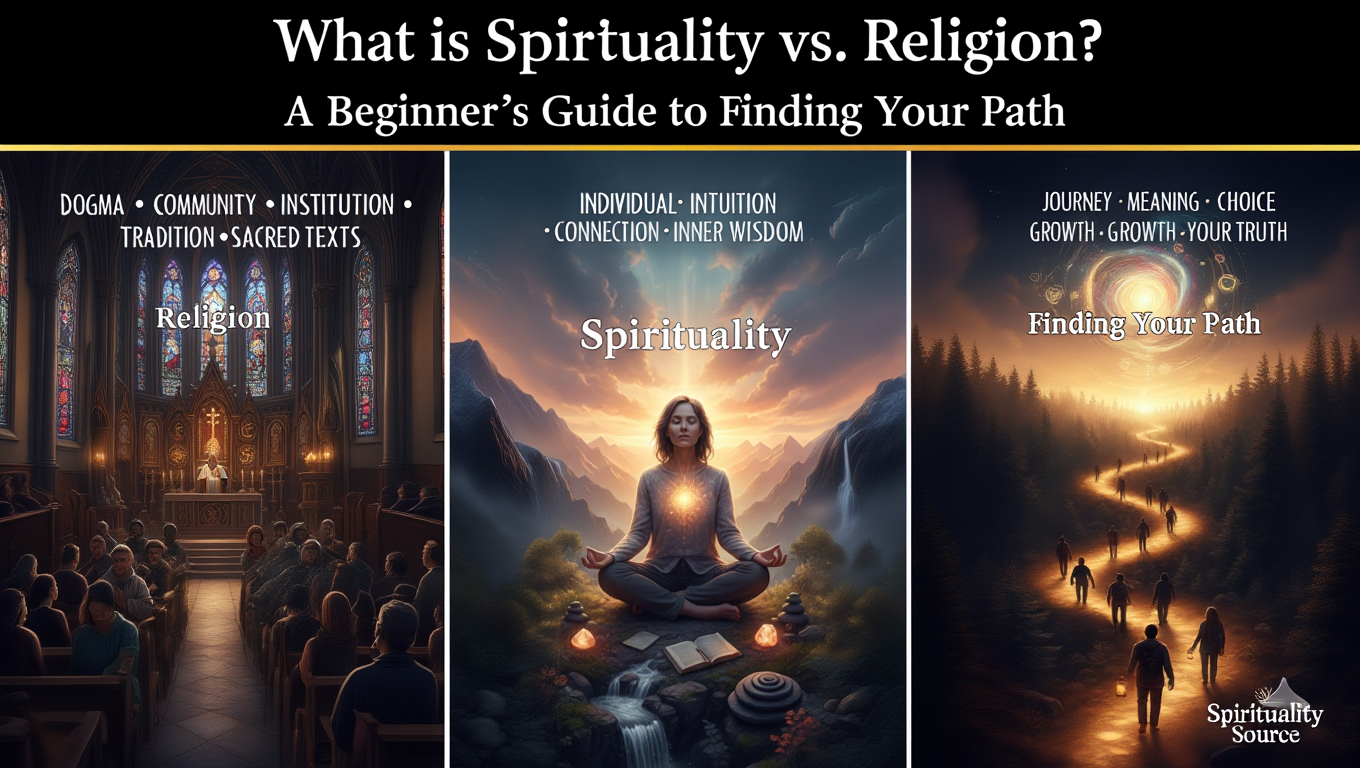
What is Spirituality vs. Religion? A Beginner’s Guide to Finding Your Path
1- What is Spirituality vs. Religion? Understanding the Core Differences
When embarking on a path of personal transformation, the most common question is: what is spirituality vs. religion? For many as I wondered, these terms are used interchangeably, but in the modern world of 2026, they represent two distinct ways of connecting with the Divine. Understanding these differences is the first step in your spiritual growth for beginners journey, allowing you to choose a path that resonates with your soul’s unique vibration.
The Fundamental Definitions
To understand the debate of spirituality vs. religion, we must look at the structure. Religion is typically an organized system of beliefs, ceremonies, and rules used to worship a god or a group of gods. It is a “collective” experience. Spirituality, on the other hand, is an individual practice of peace, purpose, and connection to something larger than oneself. It is a “personal” experience to gain through everyday of life.
2- The Psychology of Belief: Why We Crave Connection?
Before we dive into the differences, we must ask: why do humans seek either path? Psychologically, humans have an innate “meaning-making” drive.
- The Need for Structure: Religion appeals to the part of our brain that seeks order. In a chaotic world, knowing exactly what to do on a Friday or Sunday provides a “Psychological Container” that reduces stress.
- The Need for Transcendence: Spirituality appeals to our “self-actualization” drive. It satisfies the hunger for a direct, unmediated experience of the universe.
- The Biological Impact: Both paths activate the “God Spot” in the temporal lobe. Whether you are chanting in a cathedral or meditating under a redwood tree, your brain releases oxytocin and dopamine, lowering your cortisol (stress hormone) levels.
3- Why is the distinction between spirituality and religion important?
Many people feel a deep pull toward the “sacred” but find themselves, uncomfortable with the rigid dogmas often found in traditional institutions. By distinguishing between the two, you give yourself permission to explore the “Spirit” without the pressure of “Religious Law.”
- External vs. Internal Authority
In a traditional religious setting, authority usually comes from the outside—a priest, a book, or a set of ancient laws. You follow a pre-written map. In spirituality, the authority is internal. You are encouraged to look within your own heart and intuition to find what is true.
- Rules vs. Freedom
Religion often focuses on “What is Right” and “What is Wrong.” It provides a moral compass through specific commandments. Spirituality focuses on “What is Aligned.” It allows for a more fluid exploration of life, where the only “rule” is to live with love and intention.
- Community vs. Solitude
Religion provides a built-in community. This is a beautiful benefit for many. Spirituality can be practiced entirely alone, though many seekers eventually find a “soul tribe” to share their journey with. “I remember sitting in a crowded church in 2018 feeling completely alone, and it wasn’t until I sat by a lake in silence that I finally felt the connection I was looking for.”
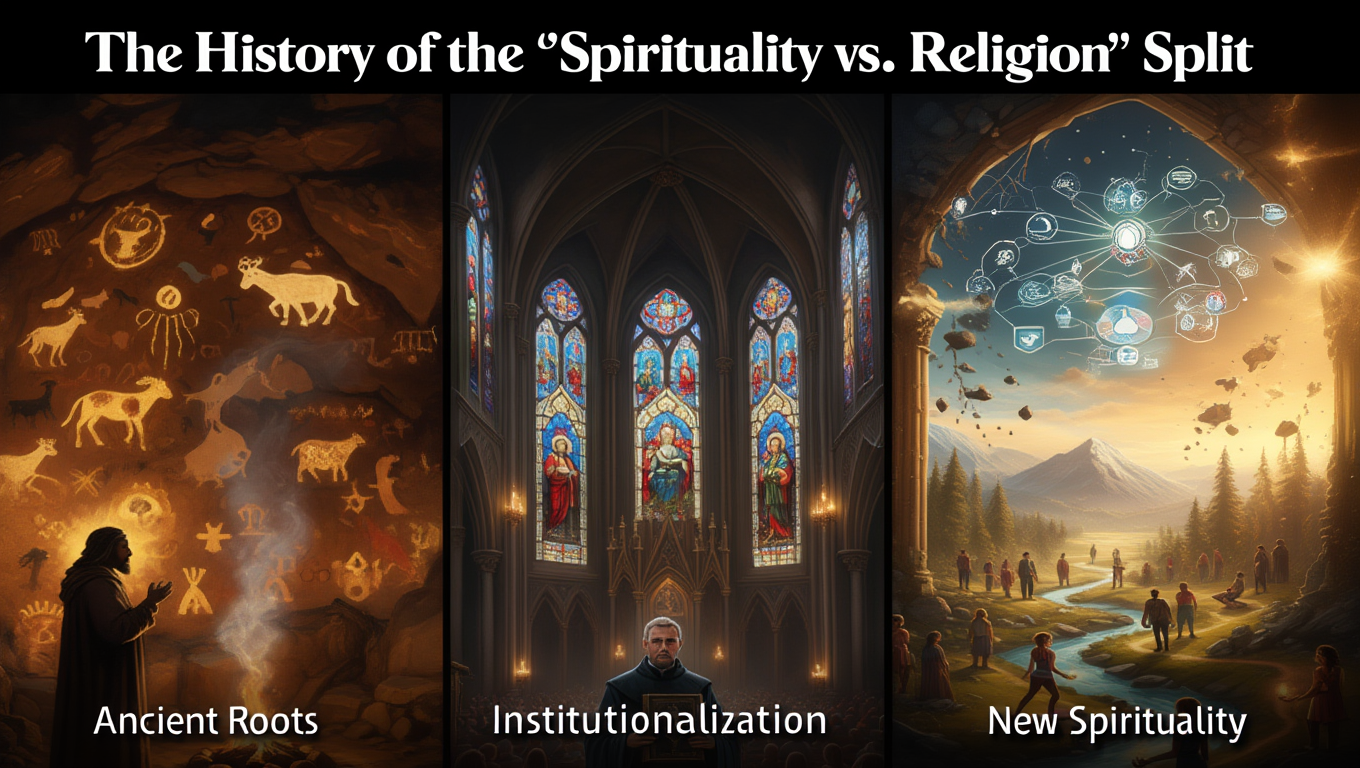
4- The History of the "Spirituality vs. Religion" Split
Historically, these two concepts were one and the same. In ancient traditions, there was no word for “religion” because spiritual practice was simply a part of daily life. The split began as societies became more institutionalized.
In 2026, we are seeing a “Great Integration.” More people identify as SBNR (Spiritual But Not Religious). This doesn’t mean they reject the Divine; it means they prefer to find it in a sunset, a deep breath, or a moment of kindness rather than just inside a specific building.
5- QUIZ: Which Path Resonates With You Right Now?
To help you navigate this, look at these two lists. Which one feels more like “Home” to you?
Path A (The Traditionalist):
- I feel safe when there is a clear set of values to follow.
- I enjoy being part of a large, established community.
- I find comfort in ancient rituals that have been performed for centuries.
- I value the wisdom of a trained leader or teacher.
Path B (The Explorer):
- I want to find my own answers through personal experience.
- I feel closest to the “Creator” when I am alone in nature.
- I like to pick and choose practices (like Yoga and Journaling) that work for me.
- I believe that all paths eventually lead to the same mountain top.
If you chose Path A, you might find deep fulfillment in a religious structure. If you chose Path B, you are likely a spiritual seeker.
6- How to Transition? From "Following" to "Flowing"
If you are coming from a religious background and want to explore spirituality, the transition can feel scary. Here is how to do it safely:
- Give Yourself “Spiritual Permission”: Realize that exploring other practices (like [Chakra healing] or Astrology) isn’t a betrayal of your upbringing; it’s an expansion of your soul and your new experiences.
- Start a Practice of Silence: Religion is often “word-heavy” (prayers, sermons). Spirituality is “silence-heavy.” Spend 5 minutes a day just listening to your breath.
- Audit Your Beliefs: Write down everything you were taught about “God” or the “Universe.” Circle the ones that feel true to your heart today. Cross out the ones that were based on fear.
- Find a Bridge Practice: Use something like Contemplative Prayer or Labyrinth Walking. These are “spiritual” practices that exist within many religions, serving as a perfect middle ground.
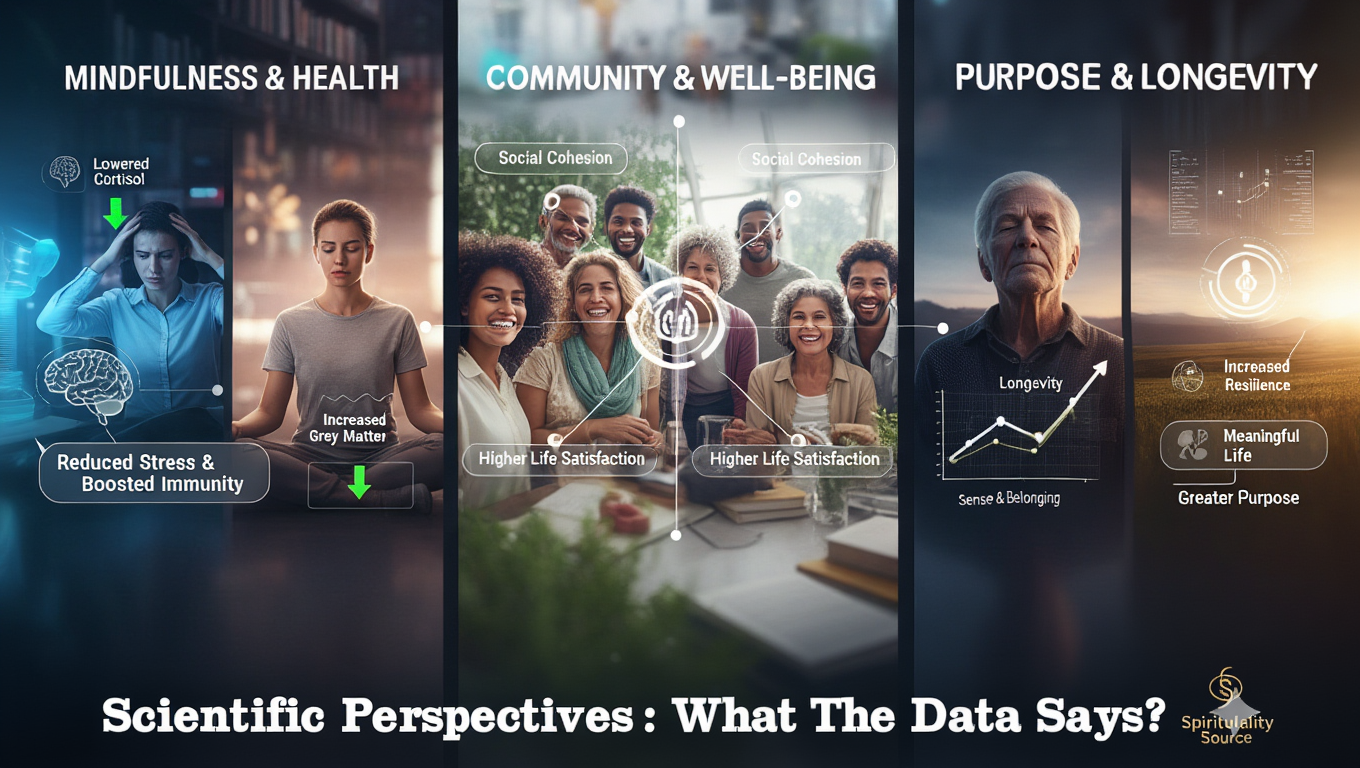
7- Scientific Perspectives: What the Data Says?
Modern psychology suggests that both paths offer immense benefits. Religion provides social support and “certainty,” which reduces anxiety. Spirituality provides “agency” and “autonomy,” which increases self-esteem.
According to studies on Neurotheology, the brain enters the same “Alpha wave” state during a formal prayer as it does during a secular meditation. The “Spirit” doesn’t care about the label; it only cares about the practice.
8- 5 Common Myths About Spirituality and Religion
- Myth: Spirituality is “New Age” fluff. Reality: It is based on the “Perennial Philosophy” that has existed for millennia.
- Myth: Religion is “Antiquated.” Reality: It provides a vital sense of belonging and “Ethical Guardrails” for billions.
- Myth: You can’t be a scientist and be spiritual. Reality: Many history-making scientists were deeply spiritual seekers.
- Myth: Being spiritual means you don’t believe in God. Reality: Most spiritual people believe in a “Higher Power”; they just use different names.
- Myth: You have to move to an ashram. Reality: You can be spiritual while working a 9-to-5.
9- Frequently Asked Questions (FAQ)
Q: Can I go to church and still be spiritual? A: Yes! Many find that the community of a church supports their individual spiritual practice.
Q: Is spirituality better than religion? A: Neither is “better.” It is about what helps you become a more loving, peaceful version of yourself.
Q: How do I explain this to my religious family? A: Focus on the “Fruits.” Show them that your spiritual practice makes you more patient, kind, and peaceful. It’s hard to argue with a better version of you.
Conclusion: Your Soul, Your Choice
Whether you choose the structure of religion or the freedom of spirituality, the goal is the same: to find your path to inner peace and purpose. The debate shouldn’t be a wall; it should be a door.
As we discuss in our [Ultimate Guide to Spiritual Growth for Beginners], the most important thing is to start. Don’t wait for the “perfect” label. Just start seeking.
Author’s Note (E-E-A-T): At SpiritualitySource.com, we believe every path is valid if it leads to the heart. This article was crafted by our editorial team to help you navigate the often-confusing world of modern belief systems.